Customize your Campaigns
Available for Stripe users, Churnkey Payment Recovery campaigns are customizable in nearly every way to help you reach your customers in a targeted, engaging, and credible approach. By running failed payment campaigns, you help your customers stay subscribed by making it easy to update their payment information.
Segmented Campaigns
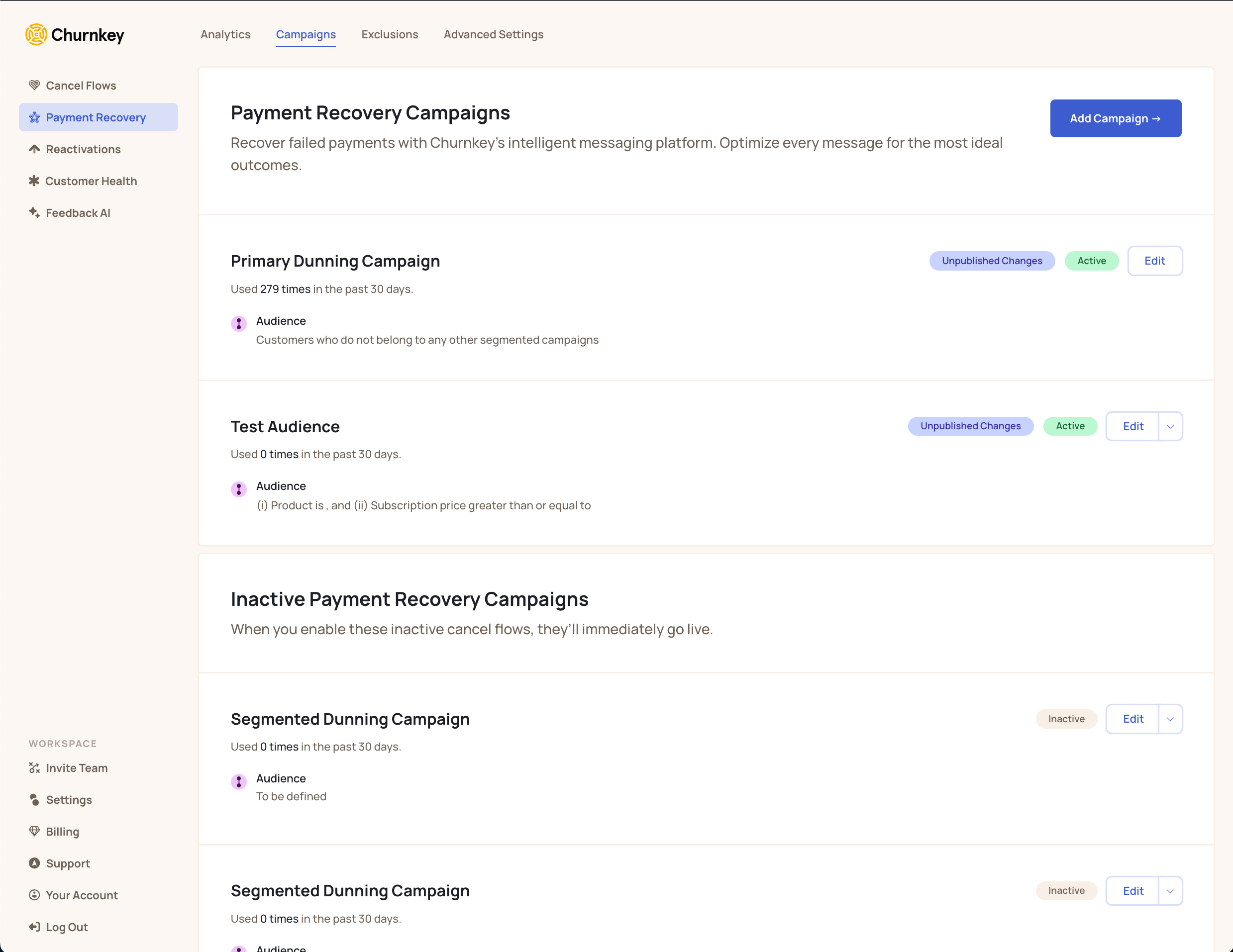
From the Payment Recovery | Campaigns page, update your Primary Dunning Campaign and add additional campaigns for better target the individual needs of your customers.
Develop segmented campaigns to reach customers on a more personalized level. Segments can be created using predefined options like subscription plan, billing interval, subscription age, and more, all seamlessly integrated from Stripe. For even greater customization, segment customers using your own custom attributes, offering nearly limitless possibilities.
Segment by Decline Type (soft vs hard)
When you add a segment filter, one of the available attributes is Payment Decline Type, with two values: Soft Decline and Hard Decline. This lets you send a different recovery campaign to a customer whose card was declined for a temporary, recoverable reason than to a customer whose card was declined for a terminal one.
This attribute applies to Stripe integrations only. Other billing providers do not surface a decline reason on their failure events, so this filter is silently skipped for them.
Two everyday examples:
- Soft Decline matches when Stripe returns a temporary, recoverable reason such as insufficient funds, an issuer hold, or a generic processing error. These customers usually recover with a retry or a quick reminder, so a shorter campaign with fewer offers is often a better fit.
- Hard Decline matches when Stripe returns a terminal reason such as an expired card, a stolen or lost card, a fraudulent block, or a card the issuer no longer authorizes. These customers will not recover without taking action, so a campaign focused on prompting them to update their payment method tends to perform better.
The classification is read from the Stripe decline reason on the most recent failed-payment attempt for each customer. Churnkey re-evaluates the bucket each time a campaign's audience filters are checked, so a customer who initially failed with a soft decline and later moved to a hard decline will move into the matching segment automatically.
Payments blocked on 3D Secure (3DS), the bank-side step behind Strong Customer Authentication (SCA), are intentionally neither Soft Decline nor Hard Decline. The card is valid, but automated retries cannot recover it — only the customer can, by completing the authentication challenge. These payments are excluded from the Payment Decline Type segment and fall through to your catch-all campaign unless you target them with the Authentication Required decline reason. Customers in this state see a one-tap Verify your card flow on the Failed Payment Wall, the hosted Payment Recovery page, and in Payment Recovery emails.
Segment by Payment Method
Alongside decline type, you can add a segment filter on the Payment Method attribute to target customers based on how they were paying when their payment failed. It has four values: Card, Bank Debit, Digital Wallet, and Other. As with other segment filters, you can match one or more values using includes or exclude them using does not include, so a single campaign can cover several payment methods at once.
This attribute applies to Stripe integrations only. It relies on Stripe's payment method details, so the filter is silently skipped for other billing providers.
The four values are grouped as follows:
- Card matches customers whose latest failed payment used a standard credit or debit card that was not part of a digital wallet.
- Bank Debit matches direct debit payment methods that pull funds straight from a bank account, such as ACH direct debit, SEPA Direct Debit, BACS Direct Debit, pre-authorized debit, and similar account-based methods.
- Digital Wallet matches wallet-based payments, including Apple Pay, Google Pay, Samsung Pay, and Stripe Link. A card that was presented through one of these wallets is counted as a digital wallet rather than as a plain card.
- Other matches any payment method that does not fall into the categories above, such as buy now, pay later options.
Segmenting this way lets you tailor your recovery messaging to the payment method. For example, a card customer may simply need to update an expired card, while a bank debit customer might need to confirm their account or mandate details, and the call to action and copy can be written to match.
The category is read from the payment method on the most recent failed-payment attempt for each customer. Churnkey re-evaluates it each time a campaign's audience filters are checked, so if a customer updates their billing to a different payment method and fails again, they move into the matching segment automatically.
Campaign Customization
Email Sequences
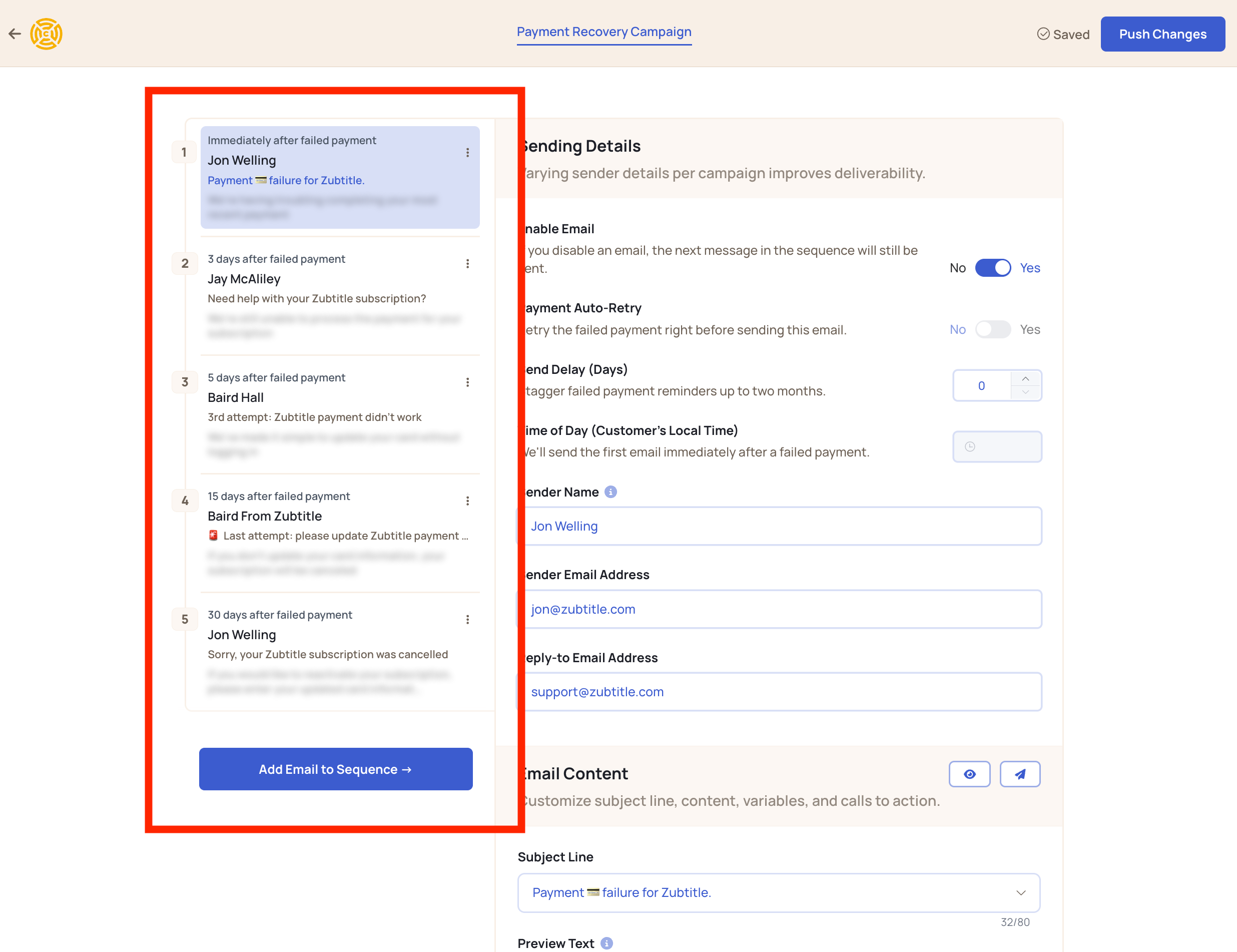
Payment recovery campaigns can include up to 10 automated emails, each one entirely customizable. Select the 3 dots icon to delete an email from your sequence or add an additional email using the blue button.
Sending Details
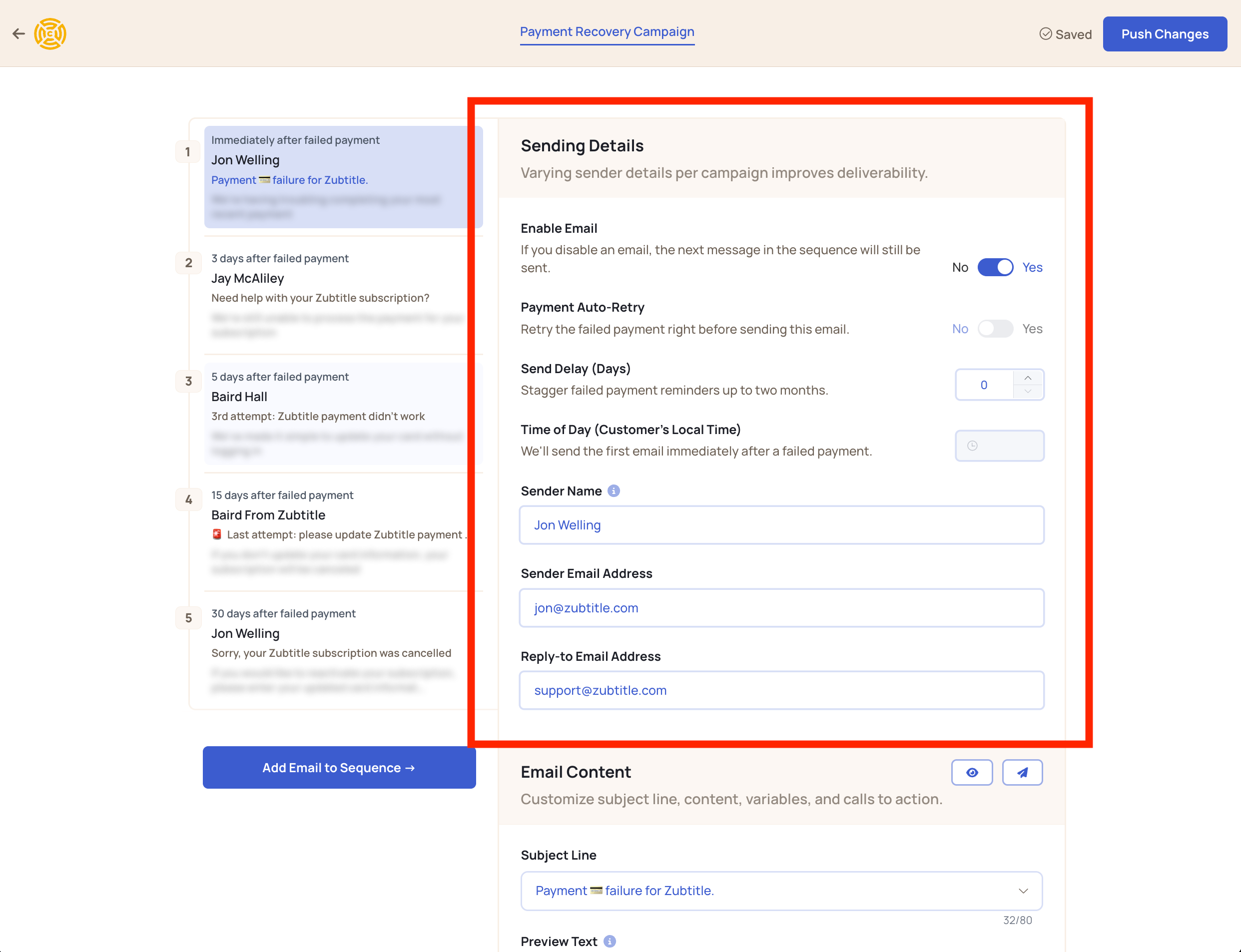
Sending details allow for customizations surrounding the identity of the sender of the email.
Timing and Frequency
Tailor your email sequence over several days, strategically spacing out delivery times.
Send Delay
Adjust the delay between the subscription end date of the initial failed payments and email dispatch — up to 60 days for comprehensive outreach.
Time of Delivery
To maximize open rates, we automatically pull in customer location details from Stripe to personalize email delivery times to each customer. Mornings are usually preferred, but experimenting with varied times can enhance engagement.
Email Domain Verification
Personalize sender details to foster trust and recognition. Consider using a name from the company or a billing representative's name e.g. Jamis from Acme, Inc. Wildcard verification allows reactivation emails to be sent from many different email addresses.
Sender Name Best Practices
Sending the emails from a diverse range of email addresses and names will help to improve the odds that a customer has worked with that employee before. By varying these sending details for each email of the campaign, emails gain credibility and deliverability.
Email Content
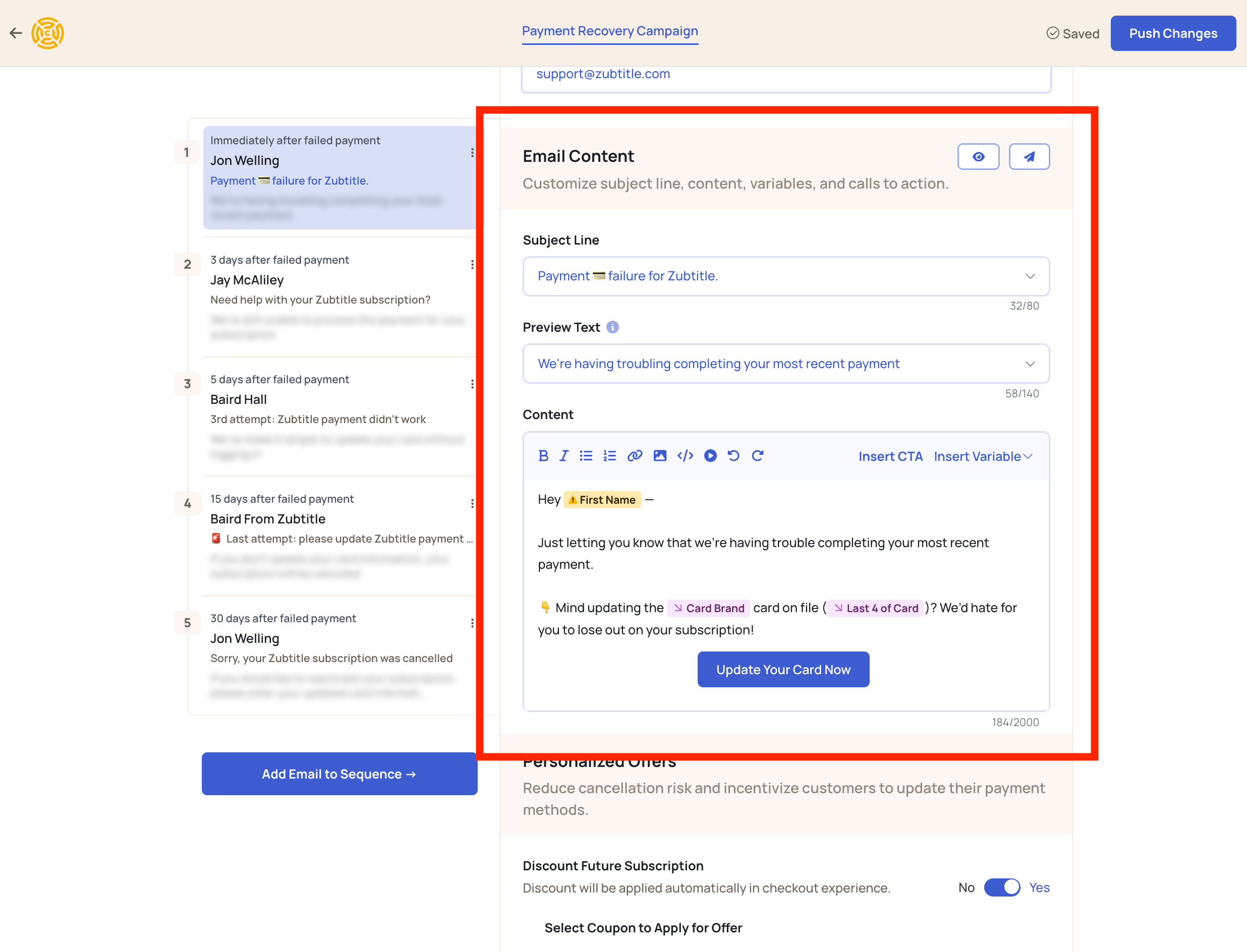
Customize the content of each individual email of your campaign.
Call to Action (CTA)
Incorporate actionable elements in emails, directing recipients to hosted pages for seamless interaction. These actionable buttons will redirect customers to your payment update domain and should reflect the action you want your customer to take upon opening the email; they could be customized to say Update Your Card, or View Offer, or anything that will entice your customer.
You can customize your domain by heading to Churnkey | Payment Recovery | Advanced Settings and providing the Payment Recovery page host. Make sure the domain is recognizable for your customers to ensure credibility; we recommend this domain to be billing.your_company.com or similar.
Please note, you can have more than one CTA button in an email, but a call to action will be automatically appended to a reactivation email if one is not provided in the email content section, to ensure customers have a link to a page where they can reactivate their subscription.
Insert Variable
We automatically pull in customer data from Stripe so that you can customize your emails to individual customers to help entice them to resubscribe. Out-of-the-box, insert Email Merge Fields of First Name and Plan Name are available. Custom attributes are also available for usage in email content after they have been added. Using custom attributes can help to personalize emails to specific customer plan usage so that you can call out information such as plan subscription start date, or the number of times a product was used, or any other relevant information. In addition, you can entice customers to stay by letting them know of any data that will be lost when they deactivate their subscriptions.
Personalized Offers
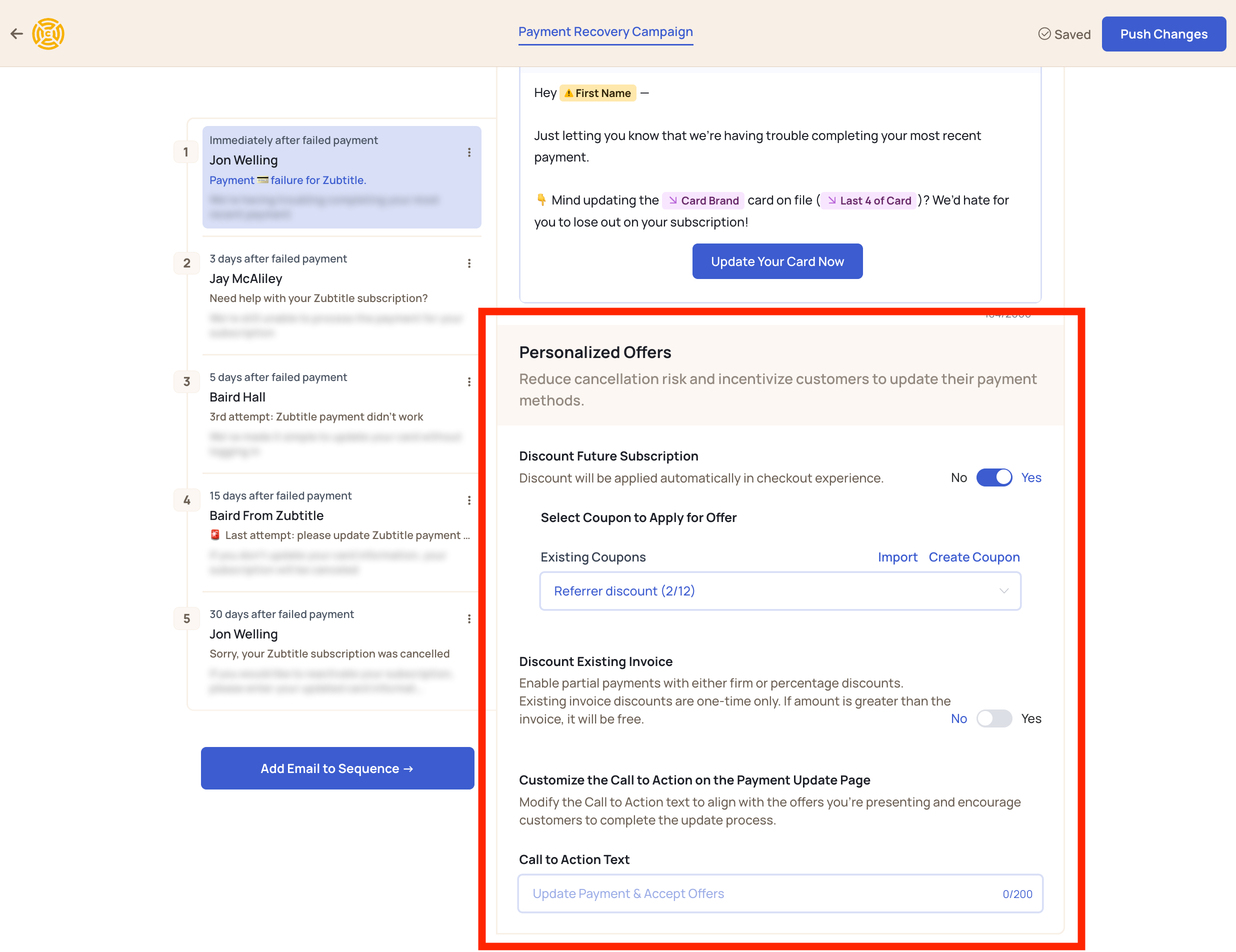
By offering a discount or coupon in a reactivation coupon, reduce cancellation risk and incentivize customers to update their payment methods.
Offer Types
Tailor your offerings to suit individual preferences with three versatile options: coupons, one-time fixed amounts, or percentage discounts on their upcoming payment. In practice, we've seen lifetime discounts work well to bring customers back to resubscribe.
Testing your Payment Recovery Campaigns
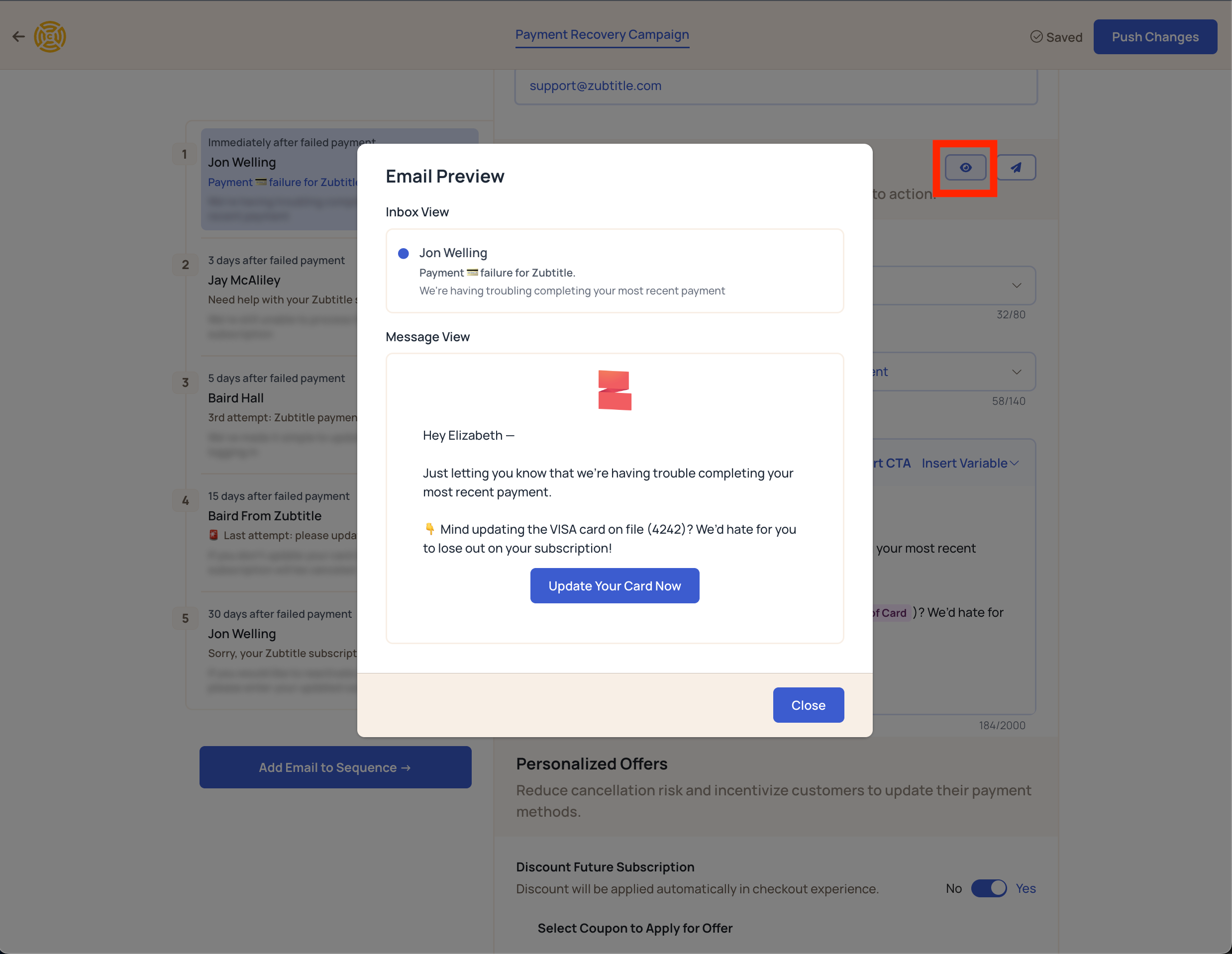 Using the eye icon under Email Content, preview your email.
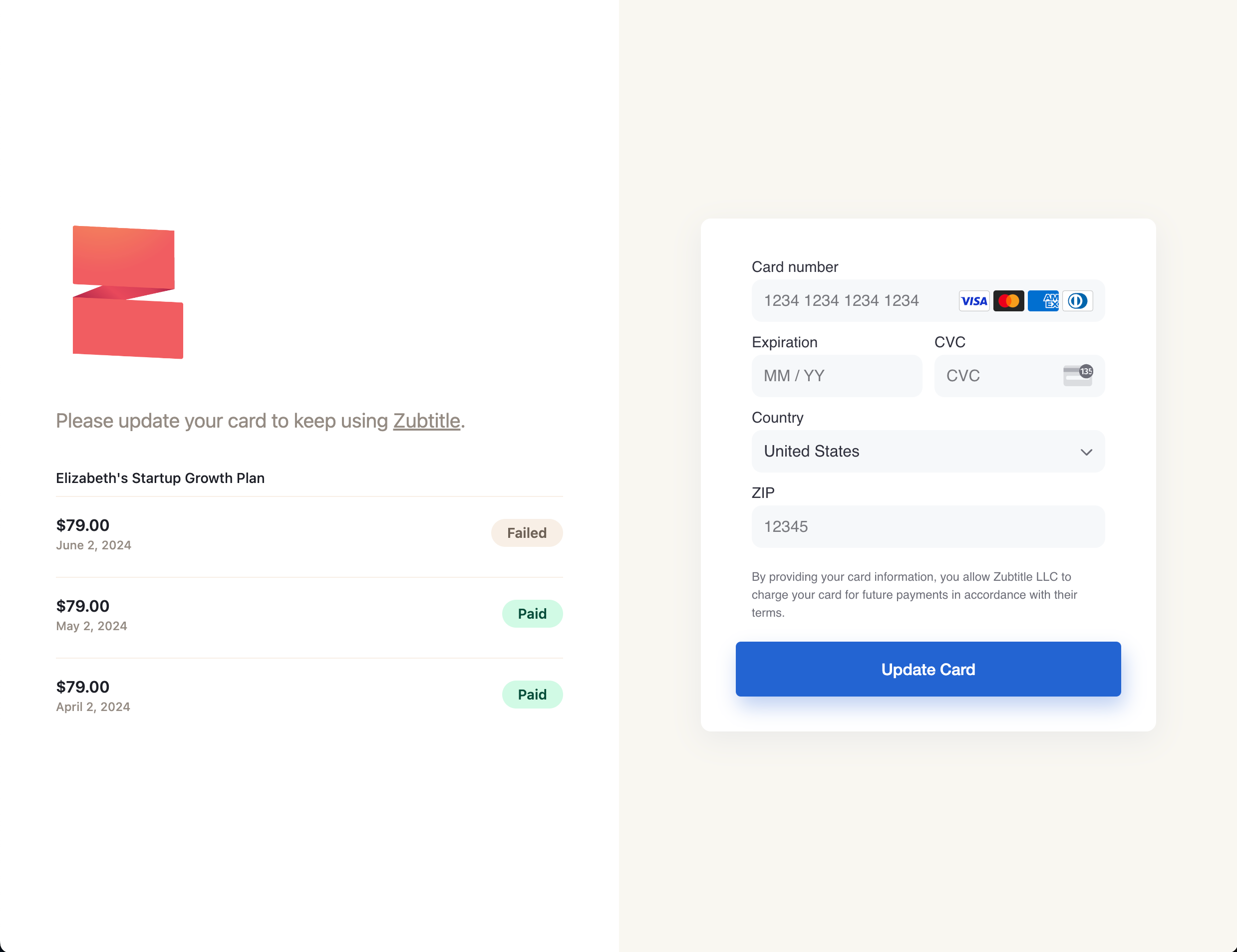
Update card demo page. View by selecting the call to action button in email preview.
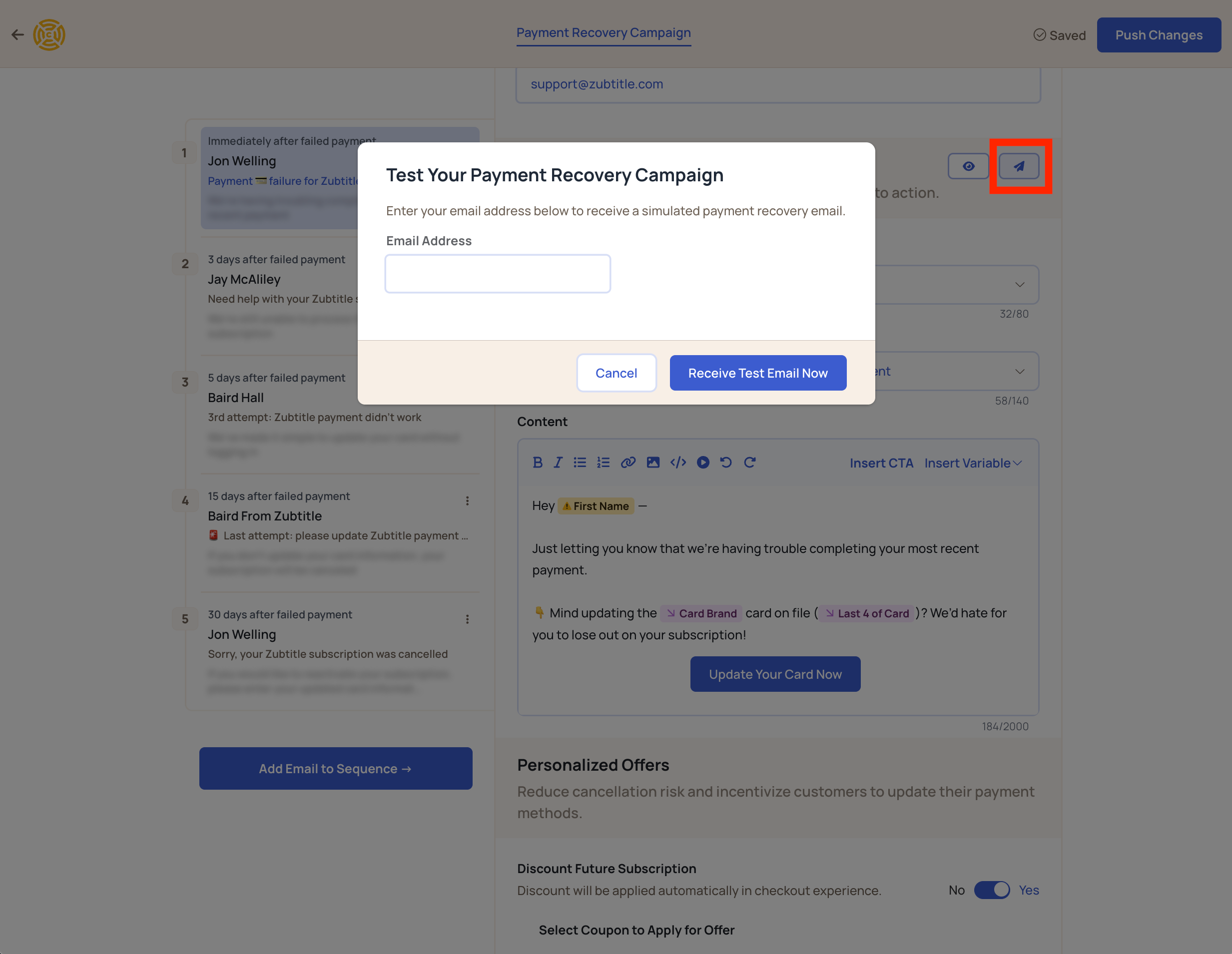
Using the paper airplane icon under Email Content, send yourself a test email.
Payment recovery page. View by selecting the call to action button in the test email.
Test your failed payment emails by selecting the eye icon to preview your email and the paper airplane icon to send a test email.
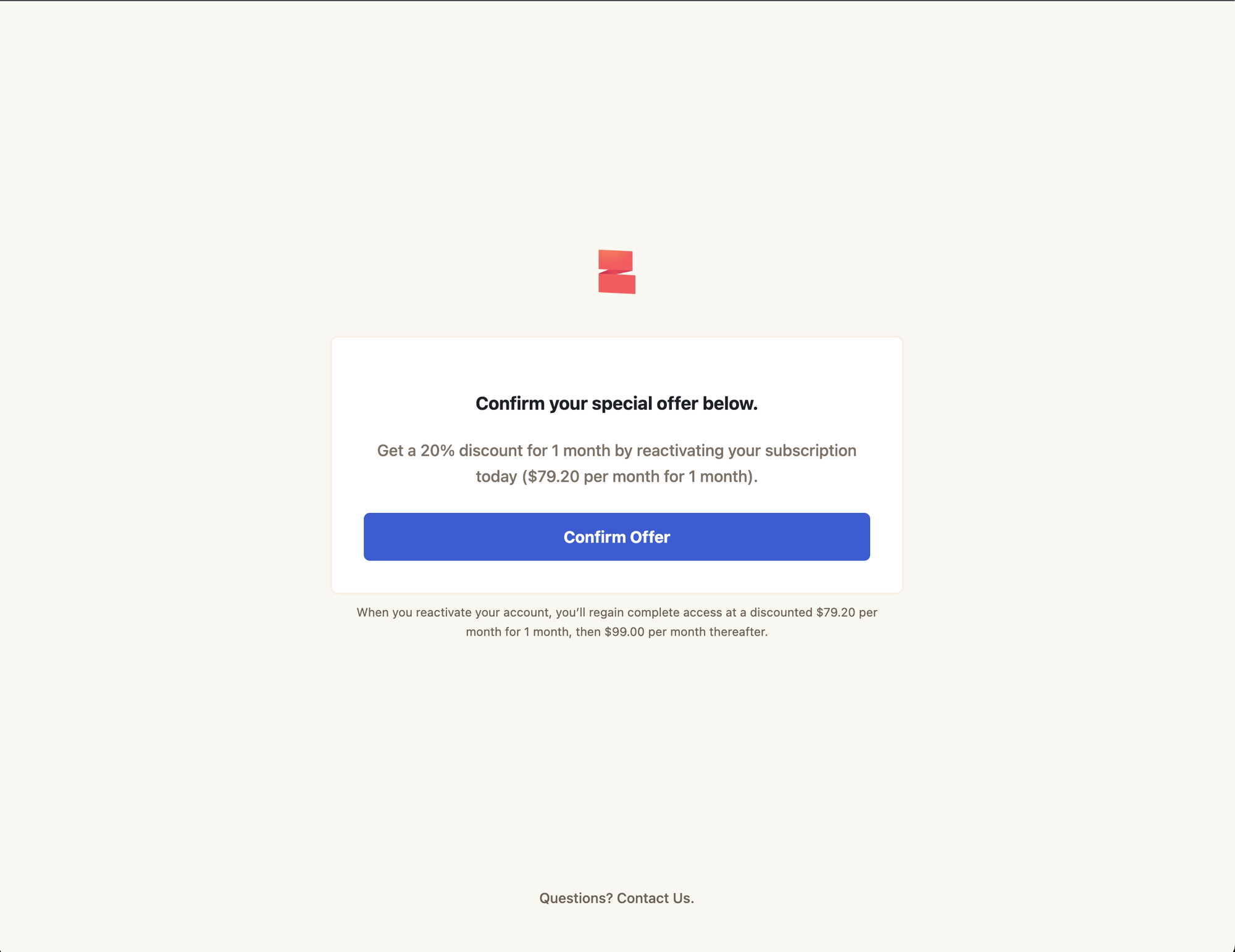
Please note, when selecting the 'View Offer' button in the email preview, you will be taken to a demo dunning page that displays a 20% off coupon and will not reflect the offer that will be shown to your customers and is selected in your email settings; the demo page will not include custom Call to Action text or offer. In order to see these customization, you can BCC your email address in order to receive these emails. Find this setting on the Payment Recovery | Advanced Settings page.
Email design
Style your Payment Recovery emails to match your brand. You can set the colors and font used across every email in a campaign, either once for your whole organization or per campaign, and you can replace an individual email with your own HTML template entirely.
Email design customization applies to Payment Recovery campaign emails only. Reactivation emails keep the standard design, with the call-to-action button using your organization's primary brand color.
Organization default design
To set a default design for all of your Payment Recovery campaigns, go to Payment Recovery > Settings and find the Email Design section.
Screenshot: Payment Recovery > Settings page with the Email Design section — color pickers, font picker, and the Preview and Save buttons, with the left navigation visible
You can customize:
- Button Color — the background color of the call-to-action button. If you leave this unset, Churnkey uses your organization's primary brand color.
- Button Text Color — the label color on the call-to-action button.
- Link Color — the color of links in the email body.
- Background Color — the color behind the email content.
- Body Text Color — the color of the email body text.
- Font — the typeface used throughout the email. The picker offers web-safe fonts only (such as Helvetica, Verdana, Georgia, and Times New Roman), because email clients like Gmail and Outlook do not load remote fonts — a web-safe font renders reliably for every recipient.
Changes are held as a draft until you select Save, so a campaign that is mid-send never picks up a half-edited design. Cancel discards unsaved edits, and once a custom design is saved, Reset to defaults returns your organization to the standard design.
Select Preview at any time to see a sample email rendered with your current settings — it works even before you have created any campaigns.
Per-campaign design
Each Payment Recovery campaign also has a Design tab in the campaign editor, so a specific campaign can look different from the rest.
Screenshot: campaign editor open on the Design tab — the Override Organization Default Design toggle and the color and font controls
By default, a campaign inherits your organization's default design. Turn on Override Organization Default Design to style this campaign independently — the controls start from a copy of your organization default, and any changes you make apply only to this campaign. If you clear a color on a campaign override, that field falls back to your organization default. Turning the toggle off returns the campaign to the organization default.
The Preview button on the Design tab renders a sample email with the campaign's effective design, and the existing preview and test email options under Email Content reflect your design as well.
Showing or hiding the call-to-action button
Every Payment Recovery email normally includes a call-to-action button that takes the customer to your payment update page. In the email editor, under the call-to-action settings, use the Show Call-to-Action Button toggle to remove the button from a specific email — for example, when you would rather link to the recovery page from within your own copy.
If you hide the button and the email content does not contain a recovery link, the editor shows a warning with an Insert recovery link shortcut. The email will still send without one, so make sure customers always have a way to reach the payment update page.
Custom HTML emails
To take full control of an individual email, turn on the Custom HTML toggle above the Content area in the email editor. You can paste your HTML directly or use Upload HTML file to load a template from your computer.
Screenshot: email editor with the Custom HTML toggle on — the HTML text area and the Upload HTML file button
A few things to know about custom HTML emails:
- Merge fields such as first name and plan name still work inside your HTML.
- The HTML is sanitized when you save — script tags and other unsafe markup are removed.
- The campaign's colors and font do not apply; your HTML defines the entire design, and the call-to-action controls are hidden because the standard button is not added.
- Include a recovery link in your template so customers can reach the payment update page.